 English
 Português
 Français
 Deutsch

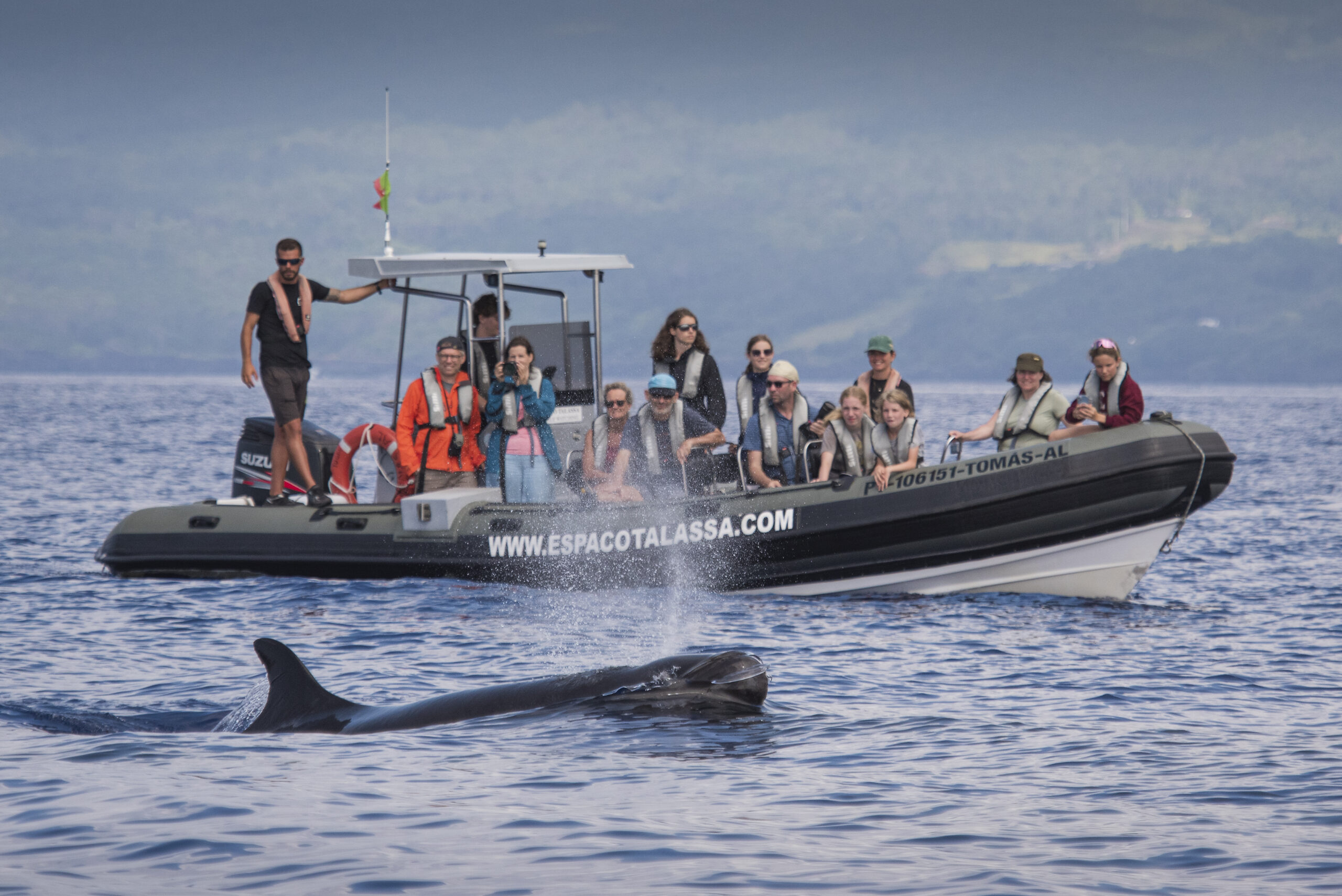
Whale watching on Pico Island means 28 cetacean species recorded around the island, and cetaceans on 99% of our trips, after more than 35 years at sea. The volcanic slopes drop to 1,000 metres a few kilometres from the shore, so deep-ocean species are within reach of a morning trip, with marine biologists on board who put the animals first.
Key Takeaways
- Sperm whales, common dolphins, Risso’s dolphins, and bottlenose dolphins inhabit Pico waters year-round; spring and summer bring migratory blue whales, fin whales, humpback whales, and Atlantic spotted dolphins.
- Espaço Talassa works with small boats (12 to 24 passengers), marine biologists as guides and one rule: “quiet and slow”. Low engine speed, at least 50 metres from the animals, and no more than 30 minutes with each group.
- Before every trip there is a 15 to 20 minute briefing: cetacean biology, how to watch them responsibly, and how Lajes went from whaling (which ended in 1987) to whale watching (we started in 1989).
- The data from every trip goes into photo-ID catalogues, the Happywhale citizen-science platform and the monitoring of deep-sea prey, work that ends up informing marine protection.
- Nobody can promise what the sea will show, but we don’t go out blind: lookouts at the Vigia da Queimada watch the ocean and guide the boats by radio, and a hydrophone lets us hear sperm whales clicking underwater.
Why Pico Island Is One of the World’s Premier Whale Watching Destinations
Under the water, Pico drops fast: deep water a few miles from the shore puts deep-ocean species within reach of a day trip. With 28 recorded species and more than 35 years of experience, Lajes do Pico ranks among the world’s top ten whale watching locations.
The island’s slopes reach 1,000 metres (3,281 ft) or more just a few kilometres from the coast, and that is rare. In most whale watching places, such as Iceland, Norway or California, you need longer trips or the right migration season to meet deep divers like sperm whales and beaked whales. Here, they live in these waters all year.
What makes Pico different is that it is small-scale and rich in species at the same time. You won’t be on a huge ship with 500 passengers. Espaço Talassa operates smaller boats for 12 to 24 people, guided by marine biologists who recognise individual animals by their flukes and behaviour. You meet whales and dolphins at their pace, not as a stop on a cruise schedule.
Here, whaling is never far away. The last whale was hunted from the island in 1987. Two years later Espaço Talassa was founded, not to make money from a dying trade, but to turn whale watching into conservation work. That hasn’t changed. Before leaving the harbour, everyone gets a briefing on cetacean biology, our history and how to watch the animals responsibly.
And then there’s the view. Pico Mountain rises 2,351 metres (7,713 ft) behind you while a sperm whale breathes at the surface. The air is clean, and there are no resorts on the horizon. This is whale watching at its purest: science, restraint and respect for the animals.
Check available dates and book your trip.
The Cetaceans You’ll Encounter: 28 Species, 3–4 Per Trip on Average
On a typical Espaço Talassa trip we record 3 to 4 cetacean species. 99% of our trips encounter at least one species, a figure built over more than 30 years of departures and more than 3,000 hours at sea a year. What you see on a given day depends on the weather and the sea, but having deep water a few kilometres from the shore (the seabed drops to 1,000 metres) helps a lot.
Year-Round Residents
Sperm whales (Physeter macrocephalus) are Pico’s signature species. They are here every month, more or less often depending on conditions. They hunt giant and colossal squid in the deep water around the island, and many carry the scars on their heads and flanks to prove it. An adult male can weigh 50,000 kg (110,000 lb), hold its breath for nearly two hours and dive to 2,000 metres (6,562 ft) or more. You’ll often see them resting at the surface, still as logs, before the next dive. Espaço Talassa keeps one of the world’s longest sperm whale photo-ID catalogues, linked since 2008 to international databases. It builds on Lisa Steiner’s pioneering research, which began in 1988, a year after the last whale was hunted in the Azores. Some individuals in our catalogue have been followed for decades.
Common dolphins (Delphinus delphis) live here all year and often travel in groups of 20 or more. They are acrobatic and noisy, leaping and spinning at the surface. Their social life is complex: they hunt together, play-fight and talk in whistles and clicks. Watching them feed is like watching a team sport: they herd small fish into tight balls and take turns to eat.
Risso’s dolphins (Grampus griseus) are equally present year-round, recognizable by their pale, heavily scarred skin and robust, blunt heads. These deep divers feed primarily on squid and fish in twilight zones where sunlight fades. Their scar patterns are so distinct that researchers use them for photo-ID, much as we do with sperm whales. They typically move in smaller, quieter groups than common dolphins.
Bottlenose dolphins (Tursiops truncatus) visit regularly throughout the year. They rank among the most intelligent cetaceans, with complex social hierarchies and learned hunting techniques that vary between populations. In Azorean waters, they are often solitary or in small family groups, moving with measured deliberation.
Striped dolphins (Stenella coeruleoalba) maintain a steady year-round presence. Their sleek bodies and distinctive facial and body stripes become apparent at close range. They are swift swimmers, frequently observed in mixed-species aggregations alongside common dolphins.
Seasonal Visitors and Peak Periods
Blue whales (Balaenoptera musculus) are migratory baleen whales, seen most in spring, when they pass through the Azores on their way north to Arctic feeding grounds. Up to 30 metres (98 ft) long and 200,000 kg (441,000 lb), they are the largest animals that have ever lived, and their low-frequency songs carry for hundreds of kilometres. When one surfaces near the boat, people usually go quiet. If you want to try your luck, have a look at our special annual blue whale package.
Fin whales (Balaenoptera physalus) are seasonal migrants, seen most in late spring. The second-largest baleen whale, they are easy to recognise by their lopsided colouring: the right side of the lower jaw is white and the left is dark, a pattern no other cetacean has. They feed by lunging into fish schools with their mouths open, taking in thousands of litres of water and filtering it through their baleen.
Humpback whales (Megaptera novaeangliae) pass northbound in spring and southbound in autumn, between their Antarctic feeding grounds and tropical breeding areas. They are famous for their acrobatics (breaching, slapping their tails and waving their long pectoral fins), and few people forget their first one. Their songs are among the most complex in nature; males sing to hold breeding territories and attract females. A song can last 20 minutes or more and be repeated for hours.
Atlantic spotted dolphins (Stenella frontalis) are summer seasonal visitors, with peak sightings as water temperatures rise. Juveniles are born unspotted and gradually accumulate white spots and scars as they age, until mature adults are heavily marked. Their tropical affinity means they prefer warmer waters, so their arrival here signals the seasonal shift.
Short-finned pilot whales (Globicephala macrorhynchus) are frequent in the warmer months. Despite the name, they are actually large dolphins. They live in close family groups led by an older female and dive deep to hunt squid. Their bonds are among the strongest of any cetacean: they will stay with a dying member of the group rather than leave it behind.
Rarer Encounters
Beaked whales, such as Northern bottlenose whales and Sowerby’s beaked whales, are seen now and then. These deep divers spend most of their lives below the surface, hunting squid at 1,000 metres (3,281 ft) or deeper. They avoid boats and come up only briefly, which makes every sighting valuable for science: we still know remarkably little about them.
Killer whales (Orcinus orca) are rare in Pico waters, but they are in our sightings database. As top predators, they hunt whales, dolphins, fish or seals, depending on the population, and pass their hunting techniques from one generation to the next. If you see them, you’ll be telling people about it for a long time.
No two trips are the same. Some days, dolphins surround the boat within minutes. Other days, a single sperm whale surfaces kilometres away and we head towards it slowly, engine low, waiting to see what it does. Every encounter is a privilege, not a guarantee. On average you’ll see 3 to 4 species per trip, and most days bring a surprise or two.
The Espaço Talassa Approach: Expertise, Ethics, and Observation at Sea
Espaço Talassa guides are marine biologists and conservation scientists, many of them also qualified skippers. We work by a “quiet and slow” rule: low engine speed, no chasing, at least 50 metres from the animals, no more than 30 minutes per encounter, and the engine off if they come to us. These are working rules, based on cetacean welfare and decades at sea.
The Team & Pre-Trip Briefing
Your guide is not a skipper who happens to know about whales. Our guides are trained marine biologists and conservation scientists first: people who have studied cetacean behaviour, ecology and population dynamics. Many are also qualified skippers. The team is multicultural on purpose, with people from the Netherlands, Germany, England, France, Brazil and Spain, and everyone looks at the sea a little differently. That mix shows in every briefing.
Before departure, your guide gives a 15 to 20 minute briefing, and it is part of the trip, not an extra. You’ll hear why Espaço Talassa exists: it was founded in 1989, two years after the last whale was hunted in the Azores in 1987, and you’ll understand what that change from whaling to whale watching meant here. The briefing explains why cetaceans are mammals, not fish (they nurse their young, breathe air and have complex social lives), and why Pico is special: its volcanic slopes drop to 1,000 metres (3,280 ft) within a few kilometres of the shore, so deep-ocean species are within reach of a morning trip. You’ll learn the rules for watching responsibly (why distances matter, why we never chase, why there are time limits) and what to look for at sea: dive sequences, feeding, calves, and the markings that tell one individual from another.
About 13,000 passengers a year sit through this briefing. It isn’t a lecture: guides take questions and adapt it to the day’s wind and sea. It’s the reason people leave our boats not only with sightings, but understanding what they saw.
The Philosophy: “Quiet & Slow” and “Each Encounter Is a Privilege”
Low engine speed and the absence of abrupt manoeuvres respect animal behaviour and allow observation of natural activity. A sperm whale surfaces and dives on its own schedule, not because a boat has raced to intercept it. You see the animal’s genuine behaviour: feeding patterns, social interactions, breathing rhythm, dive duration. Speed and noise obscure all of that.
Approach distances are at least 50 metres (164 ft) in normal conditions, 100 metres (328 ft) if there are calves, and 300 metres (984 ft) if three or more boats are near the same group. These distances avoid stress and disturbance: the animals either ignore the boat or stay calm with it there. At sea, you’ll see the guide scan the horizon and cut the engine. The boat drifts. Sometimes an animal comes over, in its own time, and those are the moments people remember.
Encounters are limited to 30 minutes per group. It’s a simple rule. When animals are around boats all the time, their behaviour changes: they become either aggressive or indifferent, and neither is good. Shorter encounters let them get back to their lives: feeding, socialising, migrating. They don’t learn to expect a boat. Our motto is “Each encounter is a privilege, not a right.” Whales don’t exist for us to watch them. We are guests in their ocean.
Espaço Talassa stopped swimming with cetaceans for ethical reasons and says so publicly. No swimming, no touching, no getting the animals used to people, because it treats a wild animal as an attraction. It cost us bookings, and we’d do it again.
The Fleet & Lookout System
Espaço Talassa operates semi-rigid boats for 12 and 24 passengers. The bigger one is the more responsible choice: more people on the same trip, for the same impact on the ocean. One boat instead of two.
Before your boat leaves the harbour, at least two professional lookouts are already at the Vigia da Queimada, an old stone lookout on the slope above Lajes. No one else in the Azores works like this. The lookouts scan the ocean with binoculars and decades of experience, and talk to the boats by radio, guiding them to the animals and telling them how fast to go and where to stop. They make sure encounters stay safe and calm. What they see in the morning also goes into the briefing before departure.
The trust between lookouts and skippers is built over years. A lookout can read a sperm whale’s dive pattern and predict where it will surface. A skipper knows how to position the boat so the animal feels undisturbed. When a lookout radios “Group of three, 300 metres northeast, moving slowly,” the skipper knows exactly how to respond. This teamwork is invisible to passengers, yet essential throughout every trip.
At sea, guides also use a hydrophone, an underwater microphone that picks up sperm whale clicks. Somewhere below, a sperm whale is hunting squid 1,000 metres (3,280 ft) down. You can’t see it, but you can hear it: a fast, metallic ticking that means it’s feeding. Hearing it changes how you think about the animal. It is not a distant shape on the surface, it’s a hunter looking for dinner in the dark.
What Happens During an Encounter: Real-Time Education at Sea
During an encounter, our marine biologist guides explain what is happening as it happens: which species, who is in the group, what they’re doing, what they eat and how they live together. Back in port, a debriefing over a drink gives you time to ask questions and take it all in. Here, watching and learning go together.
It usually starts at the Vigia da Queimada, our old stone lookout above Lajes do Pico. The lookouts call the boat as soon as they spot cetaceans. Because whales and dolphins are often only 1 to 3 kilometres (0.6–1.9 mi) from the shore, where the volcanic slopes drop steeply to more than 1,000 metres (3,300 ft), we get there quickly. We approach at low speed and slow right down well before the minimum distance of 50 metres (164 ft), or 100 metres (328 ft) if there are calves.
Once the boat is in position, your guide explains what you’re seeing. If sperm whales are diving: the tail lifting as the whale goes down, the usual 20 to 30 minute dive, and how their clicks (sometimes audible through our hydrophone) let them hunt giant squid in almost total darkness 1,200 metres (3,900 ft) below. You learn not just that they dive, but why, how deep and what for.
Common dolphins often feed together, and your guide will show you how the group rounds up fish into tight balls and takes turns to eat. Atlantic spotted dolphins show their social life in their markings and behaviour: calves stay close to their mothers, young ones play at the surface. Pilot whales, which are really the largest dolphins, travel in family groups led by females; your guide reads how the group moves and can sometimes recognise returning animals from our photo-ID catalogue, kept since 2008.
Good guides read the animals. How long they stay at the surface, how they breathe, the angle of the dive, seabirds gathering nearby: all of it says something about what the cetaceans are doing and what might come next. You learn to watch the same way, asking: why did it dive like that? Why is the group spreading out? What does that tail slap mean? The guide’s job is to help you see what is really there.
When the boat is back in port, everyone gathers ashore for the debriefing: 20 to 30 minutes of conversation over coffee or a local drink. This is where the questions come out, about behaviour, migration, conservation or the animals you just saw, and there’s no rush to answer them. Many people find out that what they saw wasn’t random: it was a family group, a feeding event, or animals passing between feeding grounds, recorded in our Happywhale database, which now holds 4,759 images and 615 identified individuals of 18 species.
You leave with more than photos: you leave knowing how these animals live and why they’re here. That’s the difference between watching and learning.
Scientific Contributions: How Espaço Talassa Data Advances Cetacean Research
Every departure from Lajes do Pico produces data for long-term research. Espaço Talassa contributes to photo-ID catalogues of sperm whales, the Happywhale platform, deep cephalopod monitoring (MONICEPH), sea turtle tracking (COSTA), and seabird monitoring (PROCELLAR-ID). So passengers are not just watching: they’re part of conservation work we’ve been doing since 1989.
Photo-ID and Happywhale: Tracking Individuals Across Oceans
Our guides photograph flukes and dorsal fins at sea. The images are compared with catalogues to identify individuals, which is called photo-identification. Each match tells us something about migration routes, social bonds, lifespan and breeding, things you can’t learn any other way.
Espaço Talassa’s sperm whale fluke catalogue, maintained since 2008, connects to international databases built on work that began with researcher Lisa Steiner in 1988. By contributing to this 35-year effort, we help map how sperm whales move through the Atlantic and navigate the deep ocean.
On Happywhale, one of the world’s largest citizen-science databases for cetacean sightings, Talassa has uploaded 4,759 images documenting 615 uniquely identified individuals across 18 species. Whales photographed off Pico have been seen again in Norway, Madeira and Cabo Verde. So the animals you meet here in summer may be feeding off Iceland in autumn or breeding near West Africa in winter. That kind of knowledge helps protect them across borders.
Deep-Ocean Prey: MONICEPH and Sperm Whale Ecology
Sperm whales dive to 1,000 metres (3,300 feet) or deeper to hunt squid, and their diet decides where they live and how often they come to Pico. MONICEPH, a deep cephalopod monitoring programme, studies sperm whale prey to understand how and where they feed.
In 2023, MONICEPH researchers working with Espaço Talassa data recorded Giant squid (Architeuthis dux) and documented the first evidence of Tropical Clubhook squid (Onykia carriboea) in Azorean waters. These discoveries matter globally. They expand our understanding of deep-sea food webs and reveal which ocean zones support the cetaceans that visit our waters.
Partners and Broader Impact
Espaço Talassa shares data with the Nova Atlantis Foundation, Mingan Island Cetacean Study, Mare Orcas, Museu da Baleia, and multiple universities. This network transforms sightings into research on social structure, migration patterns, diet, and critical habitat areas.
Conservation decisions, like where to create marine protected areas, which activities to regulate or where shipping lanes should go, depend on this kind of evidence. Every photo taken from our boats, every sighting logged and every dive explained by our biologists feeds into it. When you book a trip with Espaço Talassa, you’re also helping build the knowledge that protects these animals.
Frequently Asked Questions About Whale Watching on Pico Island
Is it guaranteed I’ll see whales?
We meet cetaceans on 99% of our trips. Still, the ocean is wild: species, group size and behaviour change every day. What is guaranteed is the company of expert marine biologists who know how to find these animals and how to watch them responsibly.
Even quiet days have their moments: the sea itself, the place that feeds 28 cetacean species, and guides who have spent decades reading these waters. Nothing is guaranteed, and that’s what makes it real.
Which species am I most likely to see?
Sperm whales are year-round residents and frequently observed. Common dolphins, Risso’s dolphins, and bottlenose dolphins visit regularly throughout the year. Spring brings blue whales, fin whales, and humpback whales; summer brings Atlantic spotted dolphins.
You’ll usually see three to four species per trip. Our guides explain what’s happening as it happens (dives, social behaviour, feeding) so you understand what you’re watching.
What’s the difference between a whale and a dolphin?
Whales and dolphins are both cetaceans: marine mammals that breathe air, nurse their young and communicate underwater. The main differences are size, teeth, social life and the way they feed.
Baleen whales like blue whales and fin whales filter-feed using baleen plates; toothed whales and dolphins use teeth to hunt prey. Our pre-trip briefing covers these distinctions in detail, so you’ll understand the animals you encounter and why cetaceans are fundamentally different from fish.
How close will we get to the animals?
We keep at least 50 metres (164 feet) from most cetaceans and 100 metres (328 feet) from mothers with calves. If three or more boats are there, we stay 300 metres (984 feet) back. We never chase animals: they set the pace and the direction.
If they approach us voluntarily, we cut engines and observe quietly. This distance allows excellent observation and photography while respecting the animals’ space and natural behavior. Each encounter is a privilege, not a right.
Do you swim with dolphins or whales?
No. Espaço Talassa voluntarily stopped swimming with cetaceans on ethical grounds. We believe that swimming with wild animals causes stress and disrupts natural behavior, regardless of how well-intentioned the interaction.
We watch from the boat, quietly and at a distance. We speak out against swimming with cetaceans because the animals’ welfare comes first. See our blog about it.
What happens if the sea is rough?
Safety is paramount. If conditions become unsafe, we return to port. Our skippers monitor the sea continuously and make decisions in the best interest of both guests and animals.
Rough seas do happen, but Lajes is on the south coast, often in the lee of the island, and our team knows these waters well. Most trips go out as planned.
How long is a typical trip?
Trips typically last three to four hours at sea, depending on conditions and animal encounters. We spend a maximum of 30 minutes observing each group, allowing time to travel, search, and potentially encounter multiple species in a single outing.
What should I bring or wear?
Dress in layers and bring something windproof: it’s cooler at sea than on land, and the wind can be strong. Bring sunscreen, sunglasses and a camera if you like. If you get seasick, ask us before the trip.
Leave heavy perfume at home: on a small boat you’ll be sitting close to other people. Our crew will tell you anything else you need to know before you board.
How does Espaço Talassa find the whales?
We use the Vigia da Queimada, an old stone lookout where professional observers watch the ocean and guide the boats by radio. We also use a hydrophone to hear sperm whale clicks underwater. Old-fashioned lookouts, a bit of technology and more than 30 years of sightings data let us find the animals and approach them properly.
Technology alone doesn’t do it; experience and patience do. Our observers know how to read the ocean.
Can I book a private trip?
Contact us to talk about a private charter. Most trips go out on shared boats with 12 or 24 passengers, which is better for the ocean and cheaper for you, and you’ll be among people who like this as much as you do.
What if I’m prone to seasickness?
Our semi-rigid boats are stable and our skippers are experienced. Seasickness tablets, ginger and keeping your eyes on the horizon all help. If you’re worried, tell the crew before or during the trip: they’ve seen it all before.
Ready to go whale watching on Pico Island? Book your trip with Espaço Talassa and join the more than 13,000 people a year who head out to sea with us from Lajes do Pico. Check available dates and book your trip.